Hello and my apologies to those that receive email updates when I make a new blog post - it appears that a draft post and a random post from 2017 were sent out over the past couple of days. I'm not sure why, I think it may be a glitch in my blogging platform or possibly my laptop's touch pad, which is starting to go kaput. I'm actually quite surprised that my computer has lasted three years in Panama, almost all of my fellow volunteers have lost at least one computer to the humidity/general living conditions haha.
New post coming in the next couple of days!
Wednesday, June 26, 2019

Saturday, May 25, 2019
Cumpleaños dorado
As a pre-teen I imagined that at 25 I'd have a car, an apartment, and a fiancé or maybe even a husband. I would be settled into a professional job, wearing slacks to work, going to classy bars on the weekend, all youthful frivolities behind me.
Well, that's clearly exactly what I've achieved. When my birthday officially began at midnight, I was crouched behind a giant log on the beach, playing Sardines with all of the volunteers. Last Friday night was spent alone at home, chopping up my veggies that were on the cusp of going bad for a stir fry, watching Jane the Virgin, and trying to shoo a giant grasshopper out of my house. My work consists of slipping down mud paths wearing rubber boots and homemade floor-length dresses, to sit and talk with families in huts with palm thatch roofs. I travel by bus, in the back of converted pickup trucks, or by foot. Occasionally I splurge on wine or a beer. I haven't gone on a date in over three years, haha.
I thought that at 25 I would be "all grown up", but honestly, I still feel so young. And that's a good thing.
The past week I spent a couple days facilitating a seminar that my fellow volunteer Eliana planned. It was for an association of botanical doctors and midwives in the Comarca. The idea was to help the members understand the science of HIV/AIDS and how it is treated, recognize potential cases of HIV or AIDS in their communities based on symptoms and health history, promote preventative behaviors, and create a better connection between the Ministry of Health and the association. The participants brainstormed strategies to deal with people who believe HIV can be cured by God or traditional remedies alone, different types of record-keeping systems for their patients, and ways to record information to send along with patients to the hospital. Often times, people arrive in the hospital without a health history and a low Spanish level, which makes it really difficult to accurately diagnose them. Hopefully these medicine men and women can help bridge this gap.
It was amazing teaching and learning from these people. There was one part where we passed out cards with symptoms, and they had to write down what types of natural medicines they would use to treat the symptoms, or decide if it was serious enough to refer a patient to the hospital. One man in my small group immediately recalled a plant for each symptom - fever, headache, infected wound, night sweats. Example - for an infected wound, you have to harvest a certain leaf, but only the baby green ones because the mature leaves are poisonous, chop it up to make a paste and apply it to the wound. It was so impressive, getting a little taste of the vast amount of botanical medical knowledge he has memorized. Before Peace Corps I never dreamed I would have the chance to participate in something like this, much less be ABLE to facilitate a seminar in Spanish.
Life is unexpected but reality is much more exciting than any of the plans I could have made for myself. Here's to 25. Happy golden birthday to me. :)
 My last Regional Meeting!
 LOL thanks to my boss Daniel for this surprise graphic
 Dinámica at the seminar - hula hoop pass.

Well, that's clearly exactly what I've achieved. When my birthday officially began at midnight, I was crouched behind a giant log on the beach, playing Sardines with all of the volunteers. Last Friday night was spent alone at home, chopping up my veggies that were on the cusp of going bad for a stir fry, watching Jane the Virgin, and trying to shoo a giant grasshopper out of my house. My work consists of slipping down mud paths wearing rubber boots and homemade floor-length dresses, to sit and talk with families in huts with palm thatch roofs. I travel by bus, in the back of converted pickup trucks, or by foot. Occasionally I splurge on wine or a beer. I haven't gone on a date in over three years, haha.
I thought that at 25 I would be "all grown up", but honestly, I still feel so young. And that's a good thing.
The past week I spent a couple days facilitating a seminar that my fellow volunteer Eliana planned. It was for an association of botanical doctors and midwives in the Comarca. The idea was to help the members understand the science of HIV/AIDS and how it is treated, recognize potential cases of HIV or AIDS in their communities based on symptoms and health history, promote preventative behaviors, and create a better connection between the Ministry of Health and the association. The participants brainstormed strategies to deal with people who believe HIV can be cured by God or traditional remedies alone, different types of record-keeping systems for their patients, and ways to record information to send along with patients to the hospital. Often times, people arrive in the hospital without a health history and a low Spanish level, which makes it really difficult to accurately diagnose them. Hopefully these medicine men and women can help bridge this gap.
It was amazing teaching and learning from these people. There was one part where we passed out cards with symptoms, and they had to write down what types of natural medicines they would use to treat the symptoms, or decide if it was serious enough to refer a patient to the hospital. One man in my small group immediately recalled a plant for each symptom - fever, headache, infected wound, night sweats. Example - for an infected wound, you have to harvest a certain leaf, but only the baby green ones because the mature leaves are poisonous, chop it up to make a paste and apply it to the wound. It was so impressive, getting a little taste of the vast amount of botanical medical knowledge he has memorized. Before Peace Corps I never dreamed I would have the chance to participate in something like this, much less be ABLE to facilitate a seminar in Spanish.
Life is unexpected but reality is much more exciting than any of the plans I could have made for myself. Here's to 25. Happy golden birthday to me. :)


The midwives and botanical doctors doing an activity, classifying common illnesses.
Tuesday, May 7, 2019
Drought, Pickles, Worms, Democracy
Since the beginning of February, my main job has been visiting communities to prepare them to receive new volunteers in August. Right now, we have twenty-two (!!!) hopeful sites on the list. It started with 23, but we had to eliminate one because we showed up for their second meeting to two police cars and three barricades (see photo). The community had blocked in the teachers' car to protest the delayed construction of the school, and their demonstration had made the news, so the governor of the Comarca showed up along with the police at the exact time our meeting was supposed to be. We were really impressed by the will of the people, but had to leave this community for maybe next year, when there isn't so much political tension.
I went back to Cerro Gallina twice with the Sustainable Agriculture Systems (SAS) staff. As you may remember they did not get a follow-up WASH volunteer last year upon my departure for various reasons, one being that there was too much division amongst families for a water or sanitation project to be successful, but the gente wanted an agriculture volunteer. The meetings went well, and I hope they are able to get a volunteer because I see lots of potential in the areas of cacao, corn, and bean production, home gardens, and marketing of their products. But going back to my site was shocking... it was so dry. Sooooo dry. Because of the drought and wind, multiple routine finca fires had gotten out of control, burning aqueduct tubes and getting dangerously close to houses. The area in front of Eduardo and Luisa's house looked like a nuclear wasteland, pure black ash. The namesake Hen Hill, above the community, was half burned. It used to be completely tree covered, and now it is half trees and half charred stumps. I asked my gente about this, in dismay, and turns out some people from Cerro Mesa burned here so they could plant. But if they cut down the trees, all of the water in your springs is gonna dry up! I cried. This can't be legal, this hill should be protected land where no one is allowed to burn. My gente agreed, but what can we do at this point? Then we hiked down to the spring, where I got all of my water last year. Although the flow was reduced in the dryest months, I was still always able to fill up my buckets. This time, it was barely trickling. I couldn't believe it, it would take hours to fill a single bucket at this rate. If it had been this dry last year....man oh man. I honestly may have thrown in the towel and said, "I'm outta here. I can't do this anymore."
The meeting in Gallina was on Thursday April 4th. For the next few days I couldn't get the image of the dry spring out of my mind. I cursed the summer and prayed please God, make it rain!!! On Sunday April 7th it started to rain. And just like that, it was winter again. It's a temporary consolation... I am relieved I never have to withstand a hot, dusty Panamanian summer again, but my gente have to deal with it every year, and it's going to keep getting longer and dryer as climate change continues to accelerate. :( :(
When I have time off from site ID I have been continuing to experiment in the kitchen, mainly with yeast breads and fermented drinks. A new vegetable stand opened up in San Felix last October, and the women who run it are amazing, bringing colorful produce from the Chiriquí highlands. They even have some of my favorites that are harder to find, like spinach and eggplant. They brought me fresh dill on special request so I made three jars of homemade dill pickles and they were so good.
I acquired some California red worms from a SAS volunteer who has a compost project going in her site and have started worm composting at my house, and I love it. I toss in small handfuls of food scraps chopped into tiny bits, egg shells, coffee grounds, etc and the worms eat it up, then their byproduct (worm poop!) becomes a rich compost. My idea is that once they reproduce enough to have sizable population in my bucket, volunteers can take handfuls of worms to their sites to start their own buckets, then pass worms on to their gente too. Why toss food scraps when they can be turned into free organic fertilizer?!
This past Sunday was Panama's quinquennial election. Official campaigning is not allowed until two months out from voting, so on March 5th empezó la locura - political party flags appeared, posters and banners were everywhere, and ads for candidates even began popping up on my Facebook newsfeed. One day I was waiting near Hato Pilón for a chiva and a truck full of Cambio Democrático party members stopped. They appeared to be joyriding up and down the mountain, shouting and waving their flags. They gave me a free ride, so that was nice. Since every position from president to mayor is up for (re)election at the same time, everyone and their neighbor seemed to be running for some office. Actually though, my next-door neighbor was running for representative. He was constantly running around leading up to the election, and surprised me when the night before he stopped and gave us a heartfelt speech on my porch about how he wanted to make the district of San Félix better for everyone, not just the wealthy and influential, and even if he lost he was going to continue fighting for equality. He ran as an independent and ended up losing, and apparently the political party of the winner was giving rides to the polls and bribing voters with $20 per vote for their candidate... On the topic of corruption, the 2009-2014 Panamanian president Ricardo Martinelli was running for mayor of Panama City, and had quite a following. Recall that he was extradited from Miami to Panama in 2017 on embezzlement charges and awaits his trial in jail. But then soon before the election, it was determined that he was actually not eligible to run because he didn't meet the residency requirement for mayor, because he was in JAIL! It sounds ridiculous but it's true haha. The new president is Nito Cortizo from the Partido Revolucionario Democrático, the center-left party that was started by President Omar Torrijos in 1979. I am optimistic about Nito because he visited the Comarca multiple times during his campaign and really seems to care about indigenous people! Speaking of Omar Torrijos, I recently read Confessions of an Economic Hitman by John Perkins. It gives a behind-the-scenes look into United States interventions in various countries, and has several chapters about Panama, Torrijos, and the events that transpired after the 1976 Torrijos-Carter treaties that turned control of the canal over to Panama. This book blew my mind and I couldn't put it down. You have to read it if you haven't yet, and please let me know if you do, I want to hear your thoughts!
Dad, Mom, and Brendan came to Panama! In Panama City, we hiked Cerro Ancón where we saw a baby sloth, visited the canal, Casco Viejo, the fish and artisan markets, and walked the Cinta Costera. We visited my host family in Santa Rita on the way to Santa Fé, where we stayed in a little bed & breakfast up in the misty mountains for a night. We hiked to see a waterfall which was underwhelming but the rainforest along the way was beautiful as always. Then we went to Santa Catalina, a little rustic surf town, where you can catch boats to Coiba National Park. We did some snorkeling at Coiba, saw two wild crocodiles, and tried surfing. It was a wonderful week of lots of delicious food, card games, and getting to share this country that has become home to me with my family!
And now, for some photos:

 I finally made it to a balsería! This is a traditional celebration in the Comarca that takes place a few times each year during the dry months. Men "fight" by taking turns throwing logs at each other's legs and trying to dodge the incoming logs. Women also participate, but by fistfighting! Copious amounts of chicha fuerte are served and homemade horns made of conch shells and turtle shells are constantly blared. I went with a bunch of volunteers. We drank chicha out of totumas (miraculously I didn't get diarrhea, I think it was the fermentation), blew horns, and a couple of the guys even fought balsa! It was loud, dusty, chaotic, and hot as hell but quite worthwhile to experience this unique Ngäbe event. This photo is of a guy wearing a nagua over his clothes (to soften the blow when the balsa log gets hurled at your calf) and a typical backpack, made out of a stuffed wild feline.
 Hiking to help out Colin and his water committee repair a toma.
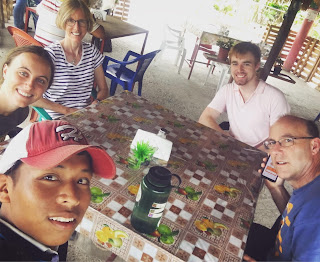 Lunch with the fam and Dionicio in San Félix! One of many selfies snapped by Dionicio.
 A hammock not made for normal-sized humans
 Visiting Milvia in Santa Rita!


 Coiba Island! Fulfilling a Panamanian dream to visit here.

I went back to Cerro Gallina twice with the Sustainable Agriculture Systems (SAS) staff. As you may remember they did not get a follow-up WASH volunteer last year upon my departure for various reasons, one being that there was too much division amongst families for a water or sanitation project to be successful, but the gente wanted an agriculture volunteer. The meetings went well, and I hope they are able to get a volunteer because I see lots of potential in the areas of cacao, corn, and bean production, home gardens, and marketing of their products. But going back to my site was shocking... it was so dry. Sooooo dry. Because of the drought and wind, multiple routine finca fires had gotten out of control, burning aqueduct tubes and getting dangerously close to houses. The area in front of Eduardo and Luisa's house looked like a nuclear wasteland, pure black ash. The namesake Hen Hill, above the community, was half burned. It used to be completely tree covered, and now it is half trees and half charred stumps. I asked my gente about this, in dismay, and turns out some people from Cerro Mesa burned here so they could plant. But if they cut down the trees, all of the water in your springs is gonna dry up! I cried. This can't be legal, this hill should be protected land where no one is allowed to burn. My gente agreed, but what can we do at this point? Then we hiked down to the spring, where I got all of my water last year. Although the flow was reduced in the dryest months, I was still always able to fill up my buckets. This time, it was barely trickling. I couldn't believe it, it would take hours to fill a single bucket at this rate. If it had been this dry last year....man oh man. I honestly may have thrown in the towel and said, "I'm outta here. I can't do this anymore."
The meeting in Gallina was on Thursday April 4th. For the next few days I couldn't get the image of the dry spring out of my mind. I cursed the summer and prayed please God, make it rain!!! On Sunday April 7th it started to rain. And just like that, it was winter again. It's a temporary consolation... I am relieved I never have to withstand a hot, dusty Panamanian summer again, but my gente have to deal with it every year, and it's going to keep getting longer and dryer as climate change continues to accelerate. :( :(
When I have time off from site ID I have been continuing to experiment in the kitchen, mainly with yeast breads and fermented drinks. A new vegetable stand opened up in San Felix last October, and the women who run it are amazing, bringing colorful produce from the Chiriquí highlands. They even have some of my favorites that are harder to find, like spinach and eggplant. They brought me fresh dill on special request so I made three jars of homemade dill pickles and they were so good.
I acquired some California red worms from a SAS volunteer who has a compost project going in her site and have started worm composting at my house, and I love it. I toss in small handfuls of food scraps chopped into tiny bits, egg shells, coffee grounds, etc and the worms eat it up, then their byproduct (worm poop!) becomes a rich compost. My idea is that once they reproduce enough to have sizable population in my bucket, volunteers can take handfuls of worms to their sites to start their own buckets, then pass worms on to their gente too. Why toss food scraps when they can be turned into free organic fertilizer?!
This past Sunday was Panama's quinquennial election. Official campaigning is not allowed until two months out from voting, so on March 5th empezó la locura - political party flags appeared, posters and banners were everywhere, and ads for candidates even began popping up on my Facebook newsfeed. One day I was waiting near Hato Pilón for a chiva and a truck full of Cambio Democrático party members stopped. They appeared to be joyriding up and down the mountain, shouting and waving their flags. They gave me a free ride, so that was nice. Since every position from president to mayor is up for (re)election at the same time, everyone and their neighbor seemed to be running for some office. Actually though, my next-door neighbor was running for representative. He was constantly running around leading up to the election, and surprised me when the night before he stopped and gave us a heartfelt speech on my porch about how he wanted to make the district of San Félix better for everyone, not just the wealthy and influential, and even if he lost he was going to continue fighting for equality. He ran as an independent and ended up losing, and apparently the political party of the winner was giving rides to the polls and bribing voters with $20 per vote for their candidate... On the topic of corruption, the 2009-2014 Panamanian president Ricardo Martinelli was running for mayor of Panama City, and had quite a following. Recall that he was extradited from Miami to Panama in 2017 on embezzlement charges and awaits his trial in jail. But then soon before the election, it was determined that he was actually not eligible to run because he didn't meet the residency requirement for mayor, because he was in JAIL! It sounds ridiculous but it's true haha. The new president is Nito Cortizo from the Partido Revolucionario Democrático, the center-left party that was started by President Omar Torrijos in 1979. I am optimistic about Nito because he visited the Comarca multiple times during his campaign and really seems to care about indigenous people! Speaking of Omar Torrijos, I recently read Confessions of an Economic Hitman by John Perkins. It gives a behind-the-scenes look into United States interventions in various countries, and has several chapters about Panama, Torrijos, and the events that transpired after the 1976 Torrijos-Carter treaties that turned control of the canal over to Panama. This book blew my mind and I couldn't put it down. You have to read it if you haven't yet, and please let me know if you do, I want to hear your thoughts!
Dad, Mom, and Brendan came to Panama! In Panama City, we hiked Cerro Ancón where we saw a baby sloth, visited the canal, Casco Viejo, the fish and artisan markets, and walked the Cinta Costera. We visited my host family in Santa Rita on the way to Santa Fé, where we stayed in a little bed & breakfast up in the misty mountains for a night. We hiked to see a waterfall which was underwhelming but the rainforest along the way was beautiful as always. Then we went to Santa Catalina, a little rustic surf town, where you can catch boats to Coiba National Park. We did some snorkeling at Coiba, saw two wild crocodiles, and tried surfing. It was a wonderful week of lots of delicious food, card games, and getting to share this country that has become home to me with my family!
And now, for some photos:

One of the three aforementioned barricades, the first two were made of fallen trees and this one was made of a miscellaneous assortment of things: PVC pipe, wheelbarrow, desk, rice pilón, metal crossbars... You can see the Ministry of Education car in the background, the new unfinished school to the left and the temporary school to the right.


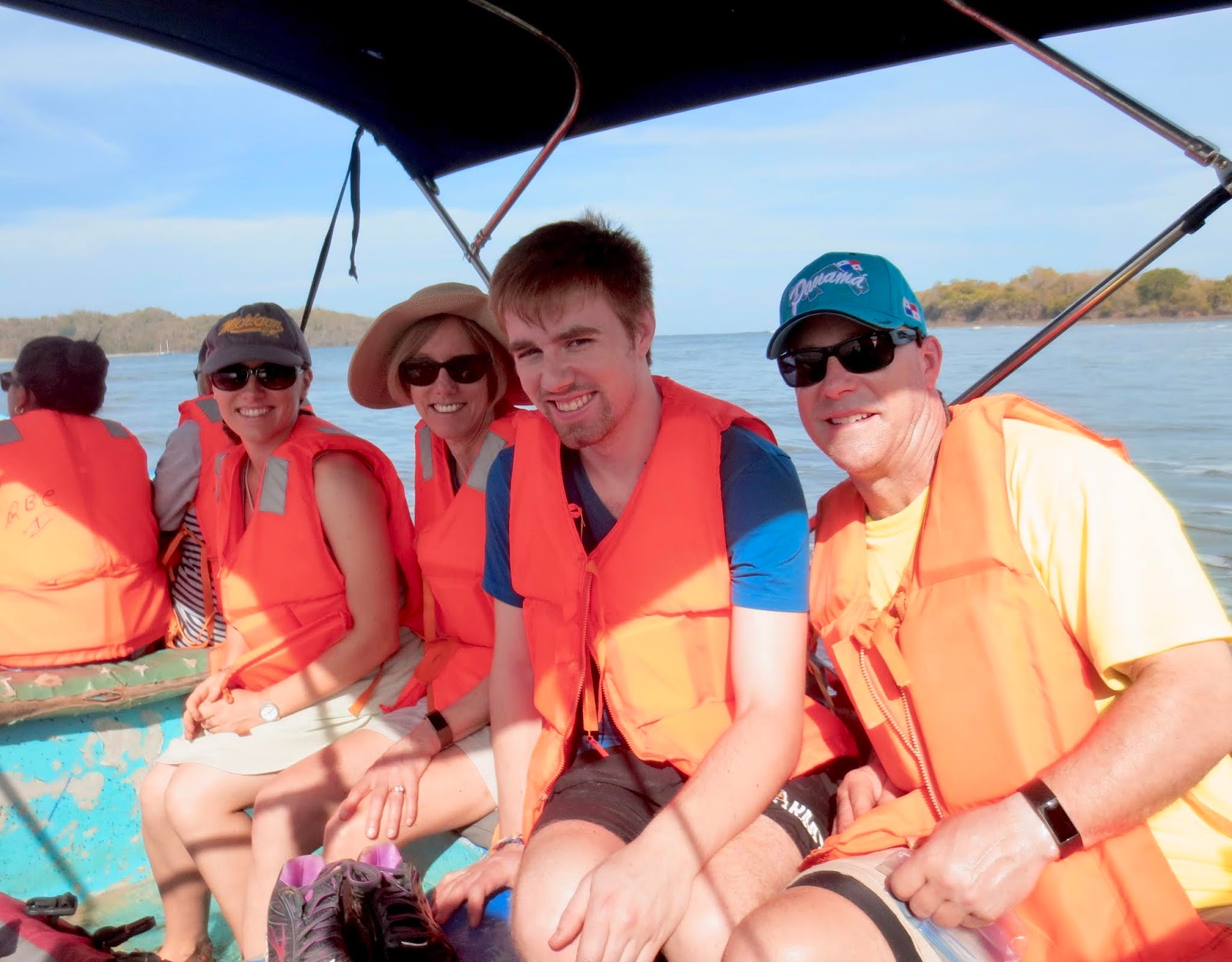
On the lancha to Isla Coiba.
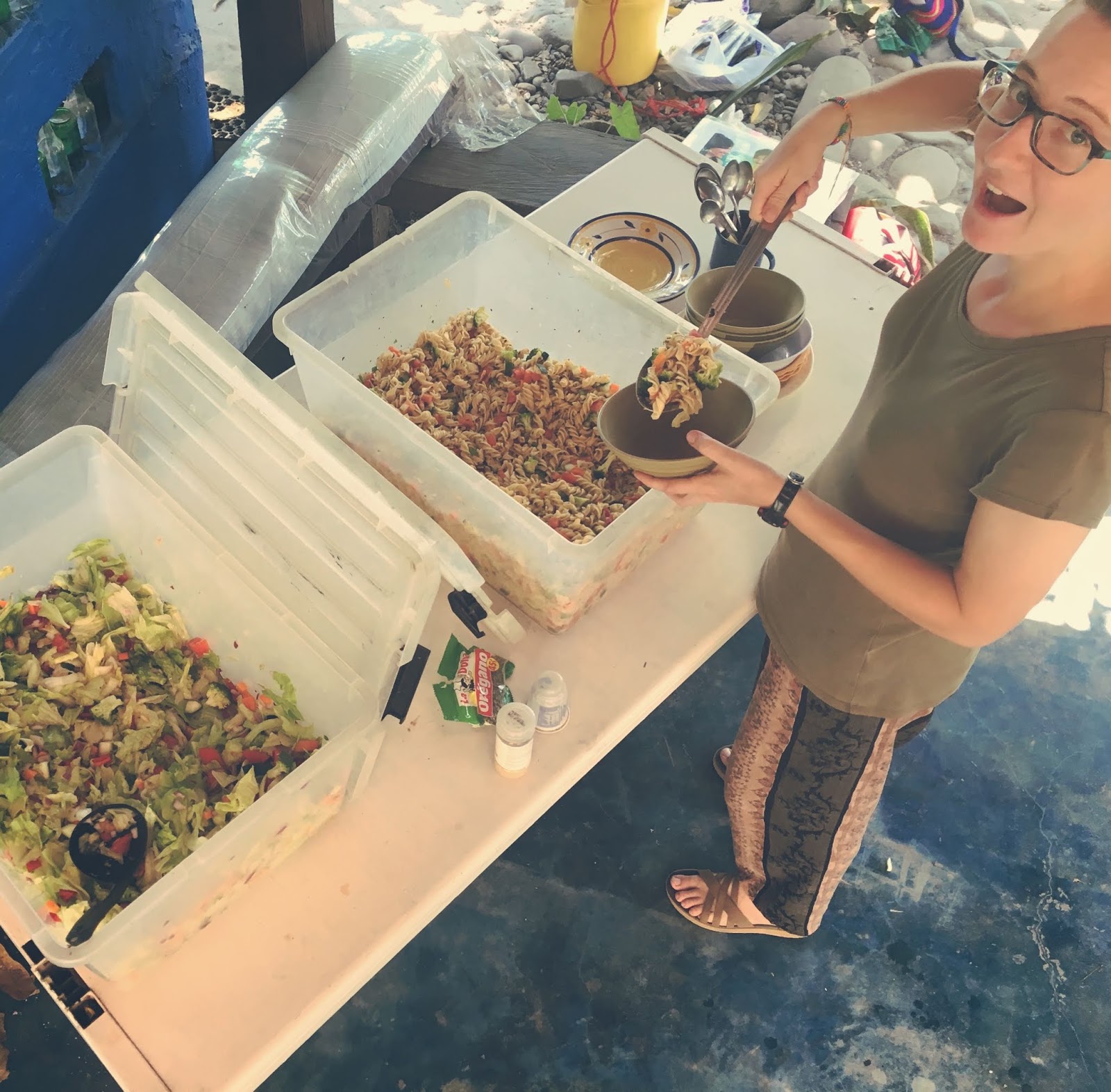
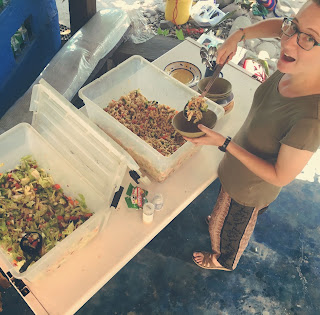
Helped facilitate a Comarca WASH weekend retreat at the beach - we served pasta and salad in plastic storage bins because we didn't have bowls big enough for 16 people.

Hiking to a potential new community. I was in the clouds the whole way, felt like I was in a terrarium. So lovely.


The four WASH RLs at site announcement for the new group of volunteers, G84.
Sunday, March 17, 2019
Life advice: you're always wrong
How many things have to happen to you before something occurs to you?
Advice for anyone living in a culture different from your own: your first instinct is always gonna be wrong. For real, you think you're right but you're wrong!
In my last post, I wrote about how I thought the officers at the highway security checkpoint were racially profiling. But I've been through the same checkpoint many times since then (yay, traveling almost every day for site ID!) and I realized I don't think that's what's actually going on. It seems to be truly random, the people they ask for identification. I'd love to chat with one of the officers and ask him, but since I'm nearly always passing by in a cramped bus, I don't think that'll be possible...

A recent example of cultural dissonance... I needed to get a new hose for the RL house bicycle pump. I bought one from the supermarket and when I was pumping up the tire later that day, I realized the tire was deflating instead of inflating. Then I saw that the rubber on the hose had a hole in it. I went back to the store and showed the salesperson the hose and she got me another one. At the checkout counter I told the cashier I wasn't buying a hose, I was just getting a replacement for a faulty one. But you have to pay for it, he said. But you sold me one that was damaged! I argued. He burst out laughing. But you bought it! There are no returns. I was pretty annoyed, but when I cooled down later I thought about it. In the culture I come from, the customer is always right. But here in rural Panama, customer satisfaction is definitely not the priority and warranties are not a thing, and I knew that. If you buy something damaged and don't realize it, that's all on you!
In Peace Corps, you don't just swallow your pride. You digest it, feel it rumbling in your tummy, and poop it out with your intestinal parasites down the latrine hole. What I mean to say is, you are forced to lower your pride over and over again, every single day, and it's not always easy to keep it down. Sometimes the feeling of selflessness lifts you, and sometimes you wallow in self-pity. You question all of the norms that you grew up with and realize that so many things in life that you thought were black and white are actually really grey. You have 2+ years of experience in this culture and still are not always sure of the culturally correct thing to do, so you give it your best go and try to be as forgiving with yourself as you are with others. You make ambiguity your home and you settle in.
And some updates on life here in the good ol' San Felix, Chiriquí...
I have been busy busy busy with new site identification. I will give you a lowdown on how it works. I get a community recommended to me by a neighboring volunteer, the Peace Corps office, a government agency, someone random I meet on a chiva, etc. If I have a contact person there, I try to call him or her and set up a day to visit. If I don't or I can't get a hold of them (which is frequent) I just show up! I go pasear - house to house greeting people and trying to find community leaders. Finding these leaders has actually been pretty easy, people seem to always know who to direct me to. We sit down, maybe drink some agua negra, and I give them a brief overview on how Peace Corps works. They ask questions, I ask questions. Mostly my questions are to make sure the site meets criteria: within an hour hike from the road, access to treatable water, cell signal within a 20 minute walk, at least 150 people, has a nearby primary school, etc. On top of that, I ask about community organizations, priorities, and try to make sure that there will be relevant agriculture or water & sanitation work, depending on which sector they're interested in. If it meets the standards and I'm getting good vibes, I will schedule a meeting with the Programming & Training Specialist (PTS) to begin the official process of making them a Peace Corps site! Sometimes I can't get a good read on my first visit so I have to visit the site twice before setting a meeting date. Sometimes I don't get great vibes or I'm not certain they meet criteria, so I don't schedule a meeting. It's kind of like speed dating, haha. I just finished two weeks of meetings with the agriculture PTS, Laura. We went to ten sites, six new and four follow-ups (currently have a PCV and are requesting another one) and we are moving forward with all of them. Woohoo! Coming up I have two weeks of water & sanitation initial visits.


Chao!
Thursday, January 31, 2019
Bus Chronicles & Privilege
"Eres la india más bonita" (You are the most beautiful Indian)
is his opening line as he approaches me as I'm waiting at the bus stop, reading my book. It's a driver for one of the nice double-decker David-to-Panama City buses. I know he means it as a compliment, but hearing it is a punch in the stomach. I am not a beautiful Indian, I'm an outsider who has been given precious permission to wear a nagua. I wear one every time I go visit potential new sites because I feel that people are instantly a little more relaxed seeing a foreigner come in when he/she is wearing local dress and greets them in Ngäbere. On instinct I narrow my eyes and reply curtly, I'm not a native, sir. He asks if I'm a pilgrim for World Youth Day happening currently in Panama City. No, I live here. I explain how I lived in the Comarca for two years and am now doing a different job here in San Félix. Oh good, that you're living here, so much better down here than in the Comarca, he states. No, I reply, actually I liked living in the Comarca better. Cooler climate, beautiful views, less pollution, surrounded by friendly neighbors. I change the subject because I'm not in the mood to hear his opinion on the Ngäbe.
He tells me about his son, who is 9 and loves cars. They took a trip to the US last year for auto-themed attractions and went to the Henry Ford in Detroit! So we talk about that a little. He tells me that his wife is my age. He looks like he's about the same age as my parents, mid-fifties. Turns out she's 28, he shows me some photos of her on his cell phone. She's beautiful, I say. Yes, he replies, I love younger women. *gross*
The bus is about to leave. He motions for me to get on and I tell him no, I'm waiting for a Tolé bus because I want a bus that takes me directly to the chiva terminal so I don't have to pay for a taxi. I'll take you for free, he says. I hesitate, and I want to say no because it's not fair, but I can't pass up a free ride on a nice bus. When we reach the Tolé entrance, I get off without paying while the Ngäbe man behind me digs through his wallet for change.
I feel ashamed, enraged about this: I get a free bus ride simply because I'm a white person. It truly makes me sick thinking about the racism I see and hear every day. This is not covert racism like the US where people save it for at home or behind a keyboard. Nope, you will hear "The Ngäbes are dirty", "The indigenous people are irresponsible", "The people of the Comarca just don't understand" out loud, in public, sometimes right in front of Ngäbes. Whenever I'm told something like this, I counter it with an example of someone hardworking or clever that I know from the Comarca. Maybe 90% of the time my story is quickly dismissed.
I got to Tolé, got my busito up to Alto Caballero and had an awesome meeting with a technician from the Ministry of Agriculture about potential new sites and how to improve the partnership between Peace Corps and the ministry. I was in high spirits coming back down to Tolé. I went to buy some veggies and as I was leaving the stand I pass two guys around my age. As soon they're behind me one of them says in a loud, snarky voice, "It looks like they left a pilgrim behind" and they both laugh. I turn around, shoot them the stink eye and say "I'm not a pilgrim." Ugh.
Bus back to San Félix, gotta pass the security checkpoint on the highway. As the busito is pulling to a stop I dig through my backpack for my passport. I look up and the officer is glaring at me. He says sarcastically, "So you're trying to camouflage yourself, huh?" Everyone on the bus turns to stare at me. He's referring to my nagua, I guess? I stammer something, not sure how to respond to this question. Peace Corps? he barks. Yes. He lets me off the hook and demands to see ID from only one person on the bus, a young guy in the front row. A Coclesano, hmm? I share an eye-roll with some of the people sitting around me. Why is this officer allowed to single people out? I ask the woman next to me. She shrugs, that's how it is.
I've had confrontations with much more aggressive officers at this particular checkpoint. Ever since one of them yelled at me in November 2017, my pulse quickens and I feel anxious every time I approach the checkpoint, hoping I won't be harassed. As a white person in this era I will probably always be a part of the dominant race so I'll never really know whats it's like to be part of the marginalized, but I will say I understand more clearly how it feels to be racially profiled, to be singled out solely because of how you look. I can imagine myself as a "foreign-looking" American worrying every time I go through airport security about getting questioned or pulled aside for a "random" pat-down. I imagine myself as black man driving at night, worrying a police officer might pull me over and assume I'm a criminal or worse, point his gun at me. And I understand now, more than ever, being a white woman is kind of like an invisible shield. If an officer is unnecessarily harsh with me at the checkpoint, I can (and I have) expressed my annoyance because I know that my whiteness is protecting me. But what if that black man driving at night responded with some equally sassy words to the officer? We know that he doesn't carry that same protection.
This post doesn't really have a rosy ending; the reality that we live in can be pretty grim. One thing that I am so much more grateful for now than I was before Panama is the diversity we have in the US. After living two years in a mono-ethnic community, where I had to get used to being constantly gaped at, being an anonymous person in the US surrounded by people of all colors felt amazing. I was walking through Chicago Union Station in December to catch the bus and I couldn't help but smile at how all different kinds of people were just coexisting and no one was staring at anyone because everyone looked different. This may sound ridiculous to you, but it was honestly magical to me haha. Obviously we have a long way to go in the States, but after Peace Corps I will cherish living in a diverse place every day of my life.
Alright, ending this post on some more positive notes:
1) Señorita Panama 2018 Rosa Montezuma, who represented Panama in Thailand at the Miss Universe Pageant in December, is part indigenous and went to elementary school in the Comarca. She's amazing! Here is my favorite photo from her Instagram. You should check out some of her other photos too, despite her fame she's incredibly down-to-earth.
2) Here you can watch Pope Francis' message (also read the English translation) to the world gathering of indigenous youth that took place in the Comarca on January 19th. At 4:41 HE SPEAKS IN NGÄBERE and totally butchers the pronunciation, but A for effort!!
3) Okay I admit this song in not empowering in any manner as Kenny Man is singing about women basically as sex objects, however, I have to say the song makes me smile. It's about how he doesn't want some foreign woman, don't want no blonde ;), he wants a dark Panamanian woman who appreciates the yuca boiling on the fire. He mentions every province including the three major indigenous provinces:
Coclesana, Guna Yala, Embera
Ngäbe Buglé nuestra Miss Panamá
Tenemos de todo no hace falta ma' na'
"We have everything, we're not missing any part"
is his opening line as he approaches me as I'm waiting at the bus stop, reading my book. It's a driver for one of the nice double-decker David-to-Panama City buses. I know he means it as a compliment, but hearing it is a punch in the stomach. I am not a beautiful Indian, I'm an outsider who has been given precious permission to wear a nagua. I wear one every time I go visit potential new sites because I feel that people are instantly a little more relaxed seeing a foreigner come in when he/she is wearing local dress and greets them in Ngäbere. On instinct I narrow my eyes and reply curtly, I'm not a native, sir. He asks if I'm a pilgrim for World Youth Day happening currently in Panama City. No, I live here. I explain how I lived in the Comarca for two years and am now doing a different job here in San Félix. Oh good, that you're living here, so much better down here than in the Comarca, he states. No, I reply, actually I liked living in the Comarca better. Cooler climate, beautiful views, less pollution, surrounded by friendly neighbors. I change the subject because I'm not in the mood to hear his opinion on the Ngäbe.
He tells me about his son, who is 9 and loves cars. They took a trip to the US last year for auto-themed attractions and went to the Henry Ford in Detroit! So we talk about that a little. He tells me that his wife is my age. He looks like he's about the same age as my parents, mid-fifties. Turns out she's 28, he shows me some photos of her on his cell phone. She's beautiful, I say. Yes, he replies, I love younger women. *gross*
The bus is about to leave. He motions for me to get on and I tell him no, I'm waiting for a Tolé bus because I want a bus that takes me directly to the chiva terminal so I don't have to pay for a taxi. I'll take you for free, he says. I hesitate, and I want to say no because it's not fair, but I can't pass up a free ride on a nice bus. When we reach the Tolé entrance, I get off without paying while the Ngäbe man behind me digs through his wallet for change.
I feel ashamed, enraged about this: I get a free bus ride simply because I'm a white person. It truly makes me sick thinking about the racism I see and hear every day. This is not covert racism like the US where people save it for at home or behind a keyboard. Nope, you will hear "The Ngäbes are dirty", "The indigenous people are irresponsible", "The people of the Comarca just don't understand" out loud, in public, sometimes right in front of Ngäbes. Whenever I'm told something like this, I counter it with an example of someone hardworking or clever that I know from the Comarca. Maybe 90% of the time my story is quickly dismissed.
I got to Tolé, got my busito up to Alto Caballero and had an awesome meeting with a technician from the Ministry of Agriculture about potential new sites and how to improve the partnership between Peace Corps and the ministry. I was in high spirits coming back down to Tolé. I went to buy some veggies and as I was leaving the stand I pass two guys around my age. As soon they're behind me one of them says in a loud, snarky voice, "It looks like they left a pilgrim behind" and they both laugh. I turn around, shoot them the stink eye and say "I'm not a pilgrim." Ugh.
Bus back to San Félix, gotta pass the security checkpoint on the highway. As the busito is pulling to a stop I dig through my backpack for my passport. I look up and the officer is glaring at me. He says sarcastically, "So you're trying to camouflage yourself, huh?" Everyone on the bus turns to stare at me. He's referring to my nagua, I guess? I stammer something, not sure how to respond to this question. Peace Corps? he barks. Yes. He lets me off the hook and demands to see ID from only one person on the bus, a young guy in the front row. A Coclesano, hmm? I share an eye-roll with some of the people sitting around me. Why is this officer allowed to single people out? I ask the woman next to me. She shrugs, that's how it is.
I've had confrontations with much more aggressive officers at this particular checkpoint. Ever since one of them yelled at me in November 2017, my pulse quickens and I feel anxious every time I approach the checkpoint, hoping I won't be harassed. As a white person in this era I will probably always be a part of the dominant race so I'll never really know whats it's like to be part of the marginalized, but I will say I understand more clearly how it feels to be racially profiled, to be singled out solely because of how you look. I can imagine myself as a "foreign-looking" American worrying every time I go through airport security about getting questioned or pulled aside for a "random" pat-down. I imagine myself as black man driving at night, worrying a police officer might pull me over and assume I'm a criminal or worse, point his gun at me. And I understand now, more than ever, being a white woman is kind of like an invisible shield. If an officer is unnecessarily harsh with me at the checkpoint, I can (and I have) expressed my annoyance because I know that my whiteness is protecting me. But what if that black man driving at night responded with some equally sassy words to the officer? We know that he doesn't carry that same protection.
This post doesn't really have a rosy ending; the reality that we live in can be pretty grim. One thing that I am so much more grateful for now than I was before Panama is the diversity we have in the US. After living two years in a mono-ethnic community, where I had to get used to being constantly gaped at, being an anonymous person in the US surrounded by people of all colors felt amazing. I was walking through Chicago Union Station in December to catch the bus and I couldn't help but smile at how all different kinds of people were just coexisting and no one was staring at anyone because everyone looked different. This may sound ridiculous to you, but it was honestly magical to me haha. Obviously we have a long way to go in the States, but after Peace Corps I will cherish living in a diverse place every day of my life.
Alright, ending this post on some more positive notes:
1) Señorita Panama 2018 Rosa Montezuma, who represented Panama in Thailand at the Miss Universe Pageant in December, is part indigenous and went to elementary school in the Comarca. She's amazing! Here is my favorite photo from her Instagram. You should check out some of her other photos too, despite her fame she's incredibly down-to-earth.
2) Here you can watch Pope Francis' message (also read the English translation) to the world gathering of indigenous youth that took place in the Comarca on January 19th. At 4:41 HE SPEAKS IN NGÄBERE and totally butchers the pronunciation, but A for effort!!
3) Okay I admit this song in not empowering in any manner as Kenny Man is singing about women basically as sex objects, however, I have to say the song makes me smile. It's about how he doesn't want some foreign woman, don't want no blonde ;), he wants a dark Panamanian woman who appreciates the yuca boiling on the fire. He mentions every province including the three major indigenous provinces:
Coclesana, Guna Yala, Embera
Ngäbe Buglé nuestra Miss Panamá
Tenemos de todo no hace falta ma' na'
"We have everything, we're not missing any part"
Monday, January 14, 2019
A Peek at 2019
A few highlights of 2018, chronologically: Acting Out Awareness camp, hosting in-service training in my community, climbing Volcán Barú, all of the HIV charlas, going to Batata, accepting my offer to stay a 3rd year in Panama, Courtney and Mara’s visit, building the storage tank with my gente, my despedida from Cerro Gallina, planning regional meeting, going to Kankintú, seeing Dinora, Mayela, and Lucila graduate from high school.
I have so much to look forward to in 2019, you guys! Meeting World Youth Day pilgrims, site development, some in-country travels, welcoming new volunteers, Panama elects a new prez, ringing the gong, two dear friends’ weddings, running my first half marathon in Detroit in October (lol help me), hopefully getting a real professional job and moving somewhere cool?!
I have so much to look forward to in 2019, you guys! Meeting World Youth Day pilgrims, site development, some in-country travels, welcoming new volunteers, Panama elects a new prez, ringing the gong, two dear friends’ weddings, running my first half marathon in Detroit in October (lol help me), hopefully getting a real professional job and moving somewhere cool?!
It’s scary but also so freaking exhilarating not knowing what I’m going to be doing a year from now! “What are you planning to do in September?” was definitely the most frequent question on my trip, and I was forced to ponder this a bit. My current plan is to find an entry-level environmental engineering job. Grad school is hopefully in my future too, but I want to get some experience in industry first. I have a list of potential cities to live in and I’m getting started with the job search via friends, LinkedIn, and whatnot.
Some other random resolutions/goals:
- Read an article from the New York Times every day I have access to my computer. There was a holiday deal so I decided to subscribe to the NYT online, and I am loving it so far.
- No more than half an hour on social media a day (this one is going to be hard)
- Study for the GRE a bit each day. I hope to take it in September or October.
- Continue to improve the Regional Leader house for all the current and future PCVs that enjoy this house
- Visit each of my volunteers in their sites!
- Dedicate myself wholeheartedly to site development. For two years I reaped what previous RLs, staff members, and community members sowed, and now it is my time to plant. Will post more about what site development entails in a future post
Being in the US was SO NICE and I started to get pretty comfortable during the 4th week, and I didn’t want to come back. I spent one day in my house in San Felix and then really needed to get out to the campo, so I visited Jo and hauled some buckets of sand, drank cowboy coffee, slept in a hammock, bathed in a creek and pooped in a hole and I felt like I was back at home again!
Ships are safe at harbor...but that's not what ships are for.
Wishing you all health, happiness, and success in 2019!
xoxo Sierra
xoxo Sierra
Bonus: some photos ~


Jo and her gente working on their water storage tank

Skiing/boarding
Snowmass with Zach, Sophia, and Michael! I am so grateful Peace Corps gifted me
this weird and wonderful family.
p.s. watch this video for a pretty darn accurate anthem representing the life of a PCV
Subscribe to:
Posts (Atom)