Saturday, February 24, 2018

Summertime, Work Time


"It is not the critic who counts; not the man who points out how the strong man stumbles, or where the doer of deeds could have done them better. The credit belongs to the man who is actually in the arena, whose face is marred by dust and sweat and blood; who strives valiantly; who errs, who comes short again and again, because there is no effort without error and shortcoming; but who does actually strive to do the deeds; who knows great enthusiasms, the great devotions; who spends himself in a worthy cause; who at the best knows in the end the triumph of high achievement, and who at the worst, if he fails, at least fails while daring greatly, so that his place shall never be with those cold and timid souls who neither know victory nor defeat.”

Living in the campo has turned me into a podcasting queen. One of my favorites lately has been “Presidential” from the Washington Post: an episode for each US President, focused mostly on their personalities and leadership styles and not necessarily what they accomplished in the White House. I recently finished the Teddy Roosevelt episode and they included his “Man in the Arena” speech, and I thought YES! I need this quote! Because surely I have been thrown into the arena of this aqueduct project, ending the day covered in dust (because dry season), sweat (because, Panama), and blood (because mosquitoes, ducking-through-barbed-wire-fence cuts) and having failed many more times than expected just in the first two weeks of a project that is going to take much longer than anticipated…


Unloading sand from the MINSA truck.

We began with materials delivery. The Ministry of Health (MINSA) provided us with three free trips from San Felix to Cerro Gallina in their truck to carry sand, rebar, form boards, blocks, PVC connections, and cement! It was my first success collaborating with a Panamanian government agency, and I hope we keep it going. The hardware store in San Felix, run by a powerhouse Chinese family, was also great at getting the materials ready and loaded for us. Then we had three more days of prep before the volunteers arrived: removing a giant fallen tree trunk from the toma area, placing and leveling the tank gravel sub-base and wood form, hauling rocks to build the toma, and cutting, bending, and tying all of the tank floor rebar.

On Monday, ten volunteers arrived in Cerro Gallina. Unfortunately, one of them fell on the hike in and twisted his ankle, and had to leave the next day and go to the hospital. The first morning we all poured the floor for the storage tank. Then in the afternoon and for the rest of the week the volunteers were split up into groups of three, and they divided and conquered. Along with the gente, we built concrete latrine floors for three families, a rainwater tank for a family that lives higher than all of the ojos de agua, began to build a new spring catchment and a 1,000 gallon storage tank for my host family's aqueduct. Each group also had a session with a youth and an adult counterpart to plan health-related behavior change plans and charlas. Dinora and Dionicio presented on water treatment, Victor chose to present on latrine use, Vidal and Victoria also on water treatment, and Marcelino on water conservation. These charlas were my favorite part of the week! After the conservation charla José told me how important it was and how he wants to teach all of the gente in Cerro Mesa. And it was sweet to watch passersby stop and gather around the galera to listen to Dinora's passionate presentation on keeping our streams clean! You go girl. I was at Benancio's house the other day hanging out and the whole family was going on and on about how much they loved their volunteer, Paige. I was proud of the host families for being so welcoming; I hope they will all remember fondly having volunteers stay with them for a week.

Dionicio was a champion helping to screed the tank floor.
Roger unbending rebar.
Dinora and her group presenting their charla.
Morning stretch circle. As you can see, Enrique was the only community member who dared to join the crazy gringos.
Ferrocement rainwater tank in progress.
Toma work with Kaly, Mars, Corinna, Charles, and Enrique!
Hunting for the sediment block in the transmission line with Roger and Walter.
IST squad: G81 volunteers in the back row, facilitators in the front row.

This week we are going to have a meeting with the aqueduct beneficiaries and create a work schedule for the rest of dry season so that we can get this project done. I'm also going to help them form an official water committee and write up a contract of use and water fees for their aqueduct in the coming months. Although with the help of the volunteers we got a lot done, we have a long way to go - the majority of the tank walls and roof, toma and rainwater tank roofs, latrine seats... Also, while working on the toma, we discovered some major issues in the transmission line like leaks and sediment blockage that I hadn't accounted for. Actually there have been a lot of unexpected issues that in keeping with the upbeat nature of this post I'm going to save those for a future post, haha. 


Previous volunteer JM "Choi" came to visit with his wife, son, and brother-in-law for a few days! It was fun to have the whole Kwitubu family together.

I've also been busy harvesting and shelling beans and corn, continuing to teach English (including tutoring two students who are taking their entrance exams to study English at university!) and working with my "Youth Health Promotors" group. We have had two meetings to plan HIV and sexual health workshops. We are presenting two this week: one here in CG and one in Cerro Mesa. Dinora, Lucila, and Dionicio have really taken the lead in the planning and promotion of these events and I'm so proud of them.

Making signs to post next to the tiendas to advertise the charla.
Rehearsing for our "tea consent" sociodrama (https://www.youtube.com/watch?v=fGoWLWS4-kU). ¡La gente desmayada no quiere té!

My amigo Alexander was a participant in acting camp last year, and this year he brought a group of kids and was a facilitator. Then he organized an HIV and sports day at the high school near his community and invited us to help him facilitate! He's a rockstar. Here are some photos from that.


Games with the girls.
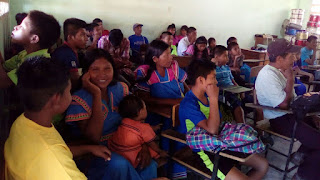
The crowd that turned out to listen to the presentations.
Alexander y yo.
Cons of summer: blazing hot sun, little water, ticks, dust, strong wind, vegetables go bad quickly because the metal roof turns my house into an oven during the day.
Pros: clothes dry fast, electronics charge fast, no worrying about events getting rained out, and my favorite: amazing sunsets nearly every evening.

Friday, January 26, 2018

Cheers To New Hats

So after 16 months living in the Comarca I finally got a sombrero pinta'o! Enrique made it by hand and I love it.

My Ngäbe getup is now complete. Photo by Dionicio.

So far in January I have tried on two completely new hats, per se, that are not my new sombrero. I know this is a cheesy analogy but I don't care. First, I spent a week as a theater director for a group of six amazing teenagers from Cerro Gallina and Cerro Mesa. And then we began work on our aqueduct improvement, and I am now lead engineer for the construction of a water storage tank, expanded spring catchment structure, three new latrines, and a rainwater catchment tank - coordinating uneducated rural farmers and soon, ten new WASH volunteers that are coming to Cerro Gallina for a week of in-service training on February 6th. Yikes!

First, Acting Our Awareness theater camp! Anyone who knows me knows that I LIVED for camp growing up, first as a camper and then a counselor. Shout out especially to Camp Anokijig and Huron's orchestra camp at Interlochen. So I couldn't wait to facilitate at AOA camp, and it was one of the best weeks of my service so far.

I love these kids. Top row: Manuel, Dinora, me, Lucila. Bottom row: Dionicio, Jonathan, Juan.

We had quite the photoshoot at the park.

Album cover?!

Photoshoot continued.

Youth from six communities across the Comarca gathered together for a week of new friends, art, and camraderie. We taught about healthy relationships, consent, HIV transmission and prevention, sexual orientation and gender identity, being a community health promoter, Ngäbe identity and culture, and more.

We had special courses every morning, and participants got to choose dance, scenery design, or chorus. I was one of the choir directors, and we prepared Puedes Llegar Lejos by Gloria Estefan and sang it at the final performance. The choir nailed it!

Each community group also spent the week preparing a play. My group's play focused on homosexuality. I purposely chose this topic because it's something that needs to be talked about more, and needs to be dealt with in a more mature way, both youth and adults alike. People use a whole slew of offensive terms like "cueco". I've heard adults of the church say that you must repent even for just feeling a same-sex attraction. If a guy wears fitted jeans, people whisper oooh, he must be gay, stay clear of him. It's really bad. I'm not here to change anyone's beliefs, but I am very vocal about the fact that as humans we have to respect everyone, regardless of their sexual orientation or gender expression. Where does "criticize and ridicule your gay neighbor" fit into the Ten Commandments? How about you shall love your neighbor as yourself?

And the kids got it. They really got it, and developed a funny and and thoughtful little soap opera about a girl who falls in love with her female teacher, tries to run away, gets ridiculed by a macho bus assistant, who then gets reprehended by her supportive friends, etc. They did an incredible job and really made the play their own. And Dionicio, Juan, and Lucila are already asking when they can see their new friends again and when we can give an HIV prevention workshop in the community! Woohoo! In the new few weeks we are going to plan it.

One of many acting drills and games to warm up for rehearsal.

Rehearsing the scene orrrr posing for the camera?!

After camp I jumped into total prep mode for our aqueduct improvement project. We have begun to prep for the construction of the tank and expansion of the toma and have selected three families that will be building latrines and one family a rainwater tank as part of In-Service Training (IST). One of our WASH coordinators, Marlana, came out to help us get started and no one showed up the first morning to work, and I felt so ashamed. I never scold people when they fail to show up to a commitment or arrive hours and hours late (I cannot count how many times this has happened) because that is the culture -- feeding your family comes first and working with the Peace Corps volunteer always comes second. And just putting food on the table is a full-time job for subsistence farmers so I get it. But doing this project will require the gente to devote a serious amount of time, and it hasn't been grasped yet. I realized that the biggest challenge for IST will be getting the gente to participate fully when there are 14 gringos in the community working. Normally workdays start leisurely around 10 or so, there is no penalty for arriving late or not showing up at all, and no one ever works after lunch. But the training week with packed 8-hour days will be totally different from anything the community has done before. In the next ten days, we have to deliver six truckloads of construction materials from San Felix, carry materials to the different worksites, get the gente ready to host volunteers in their houses, prep to pour the tank base and latrine floors, continue to prep the toma, and prep the counterparts who will be working with the volunteers to develop health charlas. This is probably the biggest task I will have my whole service and boy do I feel like I have no idea what I'm doing and I've put too much on our plate but así es. I'm off to the hardware store to schedule the deliveries!

Beginning to level for the tank.

 Excavating the toma (spring catchment).

Almost done leveling!

Regional Meeting January 2018. Viva las ardillas de la Comarca!

Thursday, January 4, 2018

The Most Wonderful Time of the Year

¡Feliz Año Nuevo! Happy New Year! Kä mrä kuin!

(I’m pretty sure there’s no Ngäbere expression for this, so we’re gonna go with “year new good” and call it a day.)

Monday, November 20th – this day was a good representation of my life from mid-November to mid-December – packed and frantic. But mostly in a good way. I left my house around 6 AM to head to San Felix to purchase supplies and prepare for a water treatment workshop the next day. The truck arrived an hour and a half late, and when I got to San Felix the whole town was without electricity and water with no guarantee it would come back on soon. So, I had to take a bus all the way to David to print out my water treatment cards and get supplies. I had decided to try something new and provide lunch at this charla, so I hiked in about 40 pounds of rice, chicken, tomato sauce, vegetables, sugar, and powdered juice. I had hoped to get back by mid-afternoon, but because of the detour to David I got back at twilight. On the way in I ran into Walter and traded my bucket of raw chicken for a flat cardboard box carrying 100 chicks (the cooperative had just gotten a new batch) for the last 15 minutes or so. My arms are not accustomed to carrying loads on my head and they alllllmost gave out and sent chicks toppling, but I made it! I was at my house salting the chicken to preserve it for the next day when Jorge stopped by and announced that I was in trouble for missing Diana’s second birthday party that afternoon. So I grabbed my solar lamp and went to explain the power outage that had made me several hours late, apologizing profusely and expressing (truthfully!) how much I wished I could have made it. “We were ALL waiting for you, for HOURS, Bei.” The family was obviously still pissed even after my apologies, and Diana’s mother Leila wouldn’t even look at me. She has since forgiven me and we’re all good now, don’t worry! I felt pretty deflated the rest of the night as I finished all of the poster papers for the charla and “laminated” the water treatment cheat sheets (with a roll of clear plastic tape, cheap solutions!)

However, the effort was worth it because this was one of the rare occasions I was satisfied with the outcome of an event. The charla was Enrique’s idea, stemming from a chronic community-wide problem with diarrhea that he sees at each gira médica (two-day visit from MINSA doctors). I based the lessons on his ideas and he introduced the charla. Although I ended up doing most of the teaching, I was ecstatic that Enrique helped in the planning and facilitation. For the last 8 months (and most important months!!) of my service, I’m really focusing on encouraging my gente to take the reins in planning, getting the word out, and leading instead of expecting me to do everything. We taught about at-home water treatment (chlorine, boiling, and solar disinfection) and storage, made a "plubo", had a chicha break, and then I presented a new topic: trash management. The gente got really into that, and it was fun to see. A few people made statements about how they want to be better examples for younger community members and want to make the “ecological landfills” that I introduced, which are basically glorified trash pits, but much better than just tossing trash wherever. Then we feasted on chicken, rice, and veggies!

The gente making a plubo = pluma + cubo (or, faucet installed in a bucket) to eliminate the common and unsanitary practice of scooping cooking/drinking/dishwashing water from buckets with bowls touched by dirty hands. I raffled off the plubo, and Enrique's household won it. His challenge was to ONLY drink water from the plubo, and only put treated water into it to see if it reduces diarrhea. Back in December, he was following the challenge!! I'm excited to hear if he thinks it has been effective after a couple months.

The next day I headed to Cerro Caña, my friend Matt’s site, to facilitate two days of Elige Tu Vida seminars in the high school. Always love doing those! Thursday after the second seminar, more friends arrived for Thanksgiving celebrations! Using his stovetop and neighbor’s fogón, we made vegan Sloppy Joe’s, kidney bean and squash curry, mashed potatoes and gravy, beef & veggie stuffed peppers, and deviled eggs. It was so delicious.

Some of the food we made.


Thanksgiving crew.

In December, we celebrated Mother’s Day and sixth grade graduation, had a workday to fix up the road for the arrival of aqueduct materials for Bajo Conejo (!!!), I taught three baking classes at Dominga’s, Marta’s, and Luisa’s houses, another trash management charla to Marcelino’s producers’ group, the second charla in my leadership series with my neighbor Corbyn, helped Vidal solicit a holiday celebration from our representante, helped with a Water Committee Seminar in Sophia’s site, and tried to start a latrine directive – this last one had to get pushed back to the new year because I literally ran out of time. Whew! I felt like a headless chicken running around trying to get all these things done before my vacation.


Heading down to lunch after the road workday.


Rice tanks a few weeks after planting.


Neighbor Corbyn helping me out with part II of the leadership charla series.

And the rice tanks looked like this right before I left for the holidays! I do believe everyone enjoyed arroz nuevo pa' la Navidad! 


Elvin bossing me around as always during a photoshoot.

Building penca hut #2.

And then I went on a glorious three-week vacation. First to Cerro Punta to celebrate at the Peace Corps Holiday Party, then to Panama City to fly out, then Ann Arbor, Madison, Racine, and back to Ann Arbor. I got to see lots of family and friends and kept quite busy, but also was able to relax plenty and soak in all of the convenient joys of America. Honestly it was bittersweet to leave all of that behind for eight more months of sweaty and unglamorous work. Dale, pues. 


Walking the Cinta Costera before my flight.


Enjoying the beginning of another Polar Vortex with friends in Racine!!

Saturday, December 9, 2017

The Story of a Day

A lot of times people ask me, “What is your typical day like?” and I never can come up with a good answer, because I don’t really have a typical day. So I will tell the story of November 14th, a day that was not extraordinary, but ended up going better than expected.

Monday the 13th – we had just finished the SENAPAN work day, group meeting, and finally a 3 pm lunch at Elsa and Marcelino’s house. Elsa had told me that she wanted me to accompany her to “a meeting” on the 14th, but I didn’t know any other details. I asked them what the plan was. Marcelino told us that his friend Catalino would be coming to pick us up at 6 AM at the entrada to take us down to this meeting. He quickly called Catalino to confirm, but there was no answer. Still he seemed sure that he would be there and said, see you at 6 tomorrow! Now, back in June Marcelino arranged for another friend with a truck to take a whole group of us to the beach for an overnight crabbing trip. And we waited from 4 pm to 11 pm, and the dude never showed up. Those seven hours, sitting on the path getting devoured by bugs and my stomach growling, were some of the most miserable hours I’ve spent in Panama. (If you were wondering, eventually José somehow got our diputado, basically the equivalent of a Senator, to send a truck at 11 pm – seriously) So I was quite doubtful this friend would come through. But I set my alarm and woke up at 4:45 AM, and it was raining steadily. I spent a half hour lying in bed, debating whether I should still go, because most of my community members will cancel plans if it’s raining. I finally left my house at 5:30 armed with my black rubber boots and umbrella, and hiked up to the entrada, arriving at 6:30. There was no one there, and it was still raining. I called Marcelino, no answer. I waited and waited and ate my packed breakfast of PB&J and an apple, wondering if Marcelino and Catalino had actually followed through and left without me at 6 AM, and finally at 7:45 I decided to turn around and hike back towards Gallina. I had walked about 2 minutes when Elsa and Marcelino appear on the path, soaking wet and loaded down with probably 30+ pounds of bodá, a local vegetable, to sell. And nearly exactly 2 minutes later, Catalino showed up. The fact that both parties showed up exactly 1 hour and 47 minutes late was quite miraculous.

He drove us to Sabanitas, a town just inside the border of the Comarca that’s pretty developed, with electricity and water and some agency offices. At this point, I had still not been told what this meeting was about. Honestly, I was a little suspicious – I’ve had some bad experiences traveling unknown places with my gente (getting stared and pointed at, getting singled out by an angry preacher in front of hundreds of people, food and water running out, etc…) We went into the Consejo Comarcal, a large multipurpose room with a stage, microphone stand, and beautiful paintings of the Comarca and Ngäbe people on the walls. We were given goodie bags from MiAmbiente (Ministry of the Environment) with recycled paper notebooks and pencils and the day's agenda and some informational booklets. Turns out, it was one of many climate change & reforestation conferences nationwide, and leaders of various groups in the Comarca were invited to learn so that they could spread the information to their constituents. So cool!! I watched Elsa and Marcelino reconnect with almost everyone who walked in – how do they seem to know the whole world? I found a wall outlet to charge my phone (this is a big deal for me, haha) said hello to the one another attendee that I recognized, Ramiro from Cerro Mesa, and wished I had coffee. The conference began, and many people from the national MiAmbiente offices in Panama City spoke, as well as local técnicos, like my community member Adriana’s brother Eduardo. They showed a PowerPoint and videos about deforestation as a national problem in Panama, the reforestation efforts that were already in place, the role of the woman in household conservation – my favorite topic, and future national goals. There was a snack break with little sandwiches and coffee – add your own milk and sugar. I can’t even explain how happy non-sugared coffee & milk made me; truly, my life in Panama has become all about the little things :)  

One of the speakers talked about the reforestation part of the 2015 Paris Accords. He explained that it may be strange to think of ourselves in the Comarca as contributors to climate change when you consider that we live without electricity, factories, or cars. But the Ngäbe can definitely contribute to combating climate change if they re-forest cleared areas, halt slash & burn agriculture, and convert to more organic practices. Over 150 countries agreed on and signed this accord, pardon to our international visitor here – he gestured towards me and the whole room turned to look at me – but the dirtiest country in the world signed it, and then backed out. Feeling that I should say something, I stood up and said shakily, I know, and as an American I’m very ashamed that we have pulled out of this very important agreement. Later, during lunch, after the rage I often feel whenever I read about Trump’s latest move had calmed down, I talked to the speaker. I explained that even though our president is crazy, I remain optimistic that the majority of American citizens and corporations care about the future of the planet and will do our best to make sure that we are doing our part, regardless of who’s in office.

After a yummy catered lunch of fried rice with veggies, fish, cabbage salad, and juice, the final activities included group brainstorming on how to transmit this information to our community members and what topics we’d like to learn about at future seminars. Before leaving, each attendee got reimbursed for their travel to & from the conference. The amounts were pre-set based on your corregimiento, and since we had gotten a free ride that morning the three of us technically made a few dollars, weird but I wasn’t complaining haha. Throughout the day Marcelino had sold all of the bodá and excitedly used his earnings to buy chicken and veggies for the family in San Félix as we waited for the chiva back up. During the hike home, Marcelino held Elsa’s hand during the slippery parts and talked animatedly about how important the conference was and how he is even more convinced that our community has the capacity to completely eliminate slash & burn. Their family has already stopped – growing rice in submerged “tanks”, Asian-style, and practicing organic agriculture. I am always inspired by this couple.

It was a good day!


Let's protect this beautiful place in which we live!